
WELCOME BONUS 300%
UP TO €2000 + 100
FREE SPINS
UP TO €2000 + 100
FREE SPINS
Home → Blackjack
Blackjack at Sportaza Casino: Variants, Rules and Payouts
What Percentage Does Blackjack Count Towards Bonus?
Sportaza Casino applies a strict 10% contribution rate to all table games, including every blackjack variant listed in the library. This ratio stands in sharp contrast to slots, which contribute 100% of every wagered euro toward the bonus turnover requirement. Consequently, high rollers pursuing the 300% welcome bonus up to €2,000 must deposit significantly more capital to clear the conditions efficiently.
The wagering requirement for the €2,000 bonus typically demands substantial turnover, and playing blackjack accelerates this process far less than slot machines do. A €100 bet on Infinite Blackjack only counts as €10 toward the total volume needed for withdrawal eligibility. This mathematical reality forces serious players to allocate their bankroll strategically between high-contribution slots and low-contribution tables.
Players should note that live dealer tables like Quantum Blackjack Plus Live fall under this same 10% restriction despite their higher stakes. The house edge further erodes the expected value, meaning the net loss during wagering will be higher than with slots. Smart gamblers calculate the exact cost of clearing the bonus before placing any chips on the felt.
Six Decks to Eight Decks in the Shoe
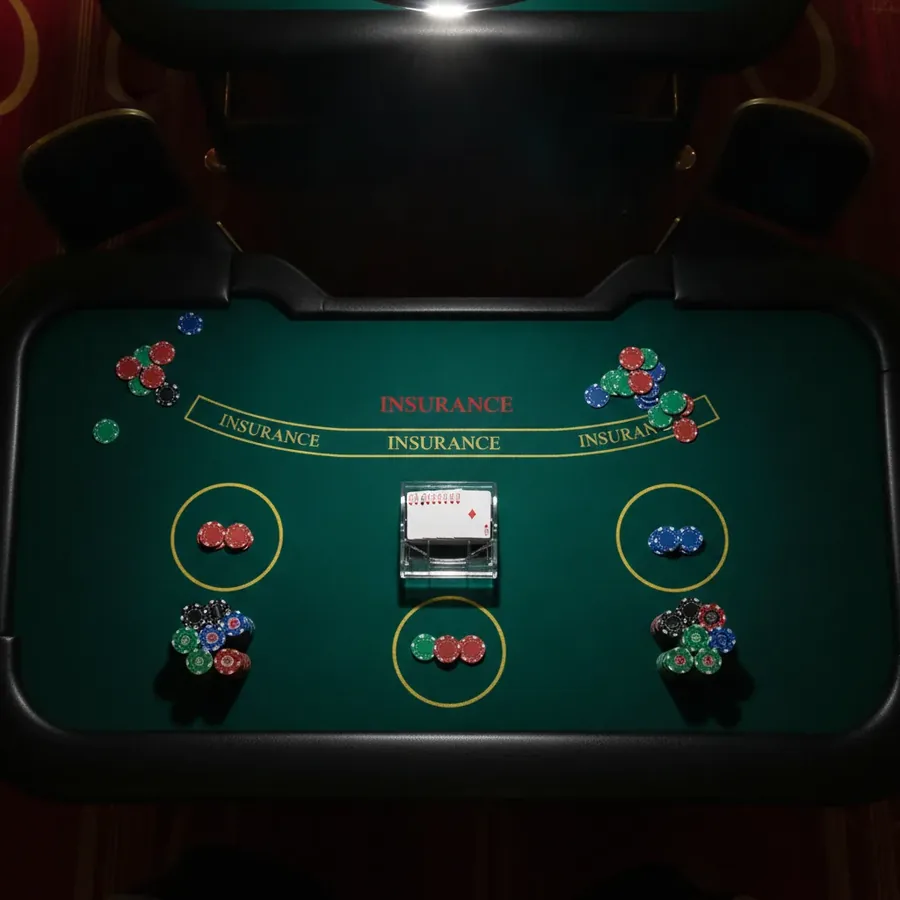
Infinite Blackjack utilizes a six-deck shoe, which establishes a baseline house edge of 0.46% when standard rules apply. This configuration offers a slight statistical advantage over eight-deck games, reducing the casino's edge by approximately 0.02 percentage points per hand dealt. High rollers benefit from this marginally improved odds profile when employing optimal basic strategy consistently.
Conversely, insurance bets in these six-to-eight deck games carry a severe 7.47% house edge, making them highly unfavorable for long-term play. The theoretical return to player drops to just 92.53%, drastically lowering the expected value compared to the main game. Even professional analysts recommend avoiding this side bet unless counting cards reveals a true count of plus three or higher.
Blackjack Party by Evolution also operates with multiple decks, maintaining similar statistical properties regarding deck penetration and card distribution. The presence of two moderators does not alter the underlying mathematics, which remain tied to the specific rule set of each table. Players must verify the exact deck count at their specific table to assess the precise house edge accurately.
Blackjack Payout 3:2 Explained in Detail
A natural blackjack paying 3:2 returns 150 euros for every 100 euros wagered, preserving the optimal house edge of 0.15% in single-deck variants. This payout structure is critical for maintaining the high theoretical return of 99.85% found in classic single-deck games. Any deviation from this ratio significantly impacts the long-term profitability for the player.
Switching to a 6:5 payout structure increases the house edge by exactly 1.39 percentage points, raising it to 1.85%. On a 100 euro bet, a winning blackjack now pays only 120 euros instead of 150 euros, costing the player substantial value over time. This reduction is more damaging than almost any other rule change available in modern casinos.
High rollers must actively avoid tables offering 6:5 payouts, as the increased house edge negates the benefits of skilled play. Variants like Blackjack 6 Decks S17 retain the favorable 3:2 payout, keeping the house edge low at 0.46%. Always check the paytable before sitting down to ensure the game meets professional standards.
Highroller from 500 EUR per hand
Infinite Blackjack accommodates high rollers with betting limits ranging from one euro up to five thousand euros per hand. This upper limit allows serious players to place substantial wagers without hitting table maximums that restrict large-volume betting strategies. The unlimited seating feature ensures that high-stakes action remains accessible regardless of crowd density at the virtual table.
Quantum Blackjack Plus Live also supports bets up to five thousand euros, integrating quantum multipliers that can boost wins by up to 1,000 times. These multipliers apply to three-card combinations totaling twenty-one points, adding an extra layer of volatility to high-stakes gameplay. The base house edge remains at 0.57% with optimal strategy, but the multiplier potential changes the risk profile.
Blackjack Party sets a lower maximum stake at one thousand euros, catering to mid-range players rather than extreme high rollers. Despite the lower cap, the party atmosphere and dual moderators create a unique environment for larger bets within that limit. Players seeking stakes above one thousand euros must choose between Infinite or Quantum variants exclusively.
What Hole Card Means at a Live Table
Live dealer blackjack games utilize electronic shoes or continuous shuffling machines, eliminating the traditional hole card procedure entirely. Instead, cards are dealt face-up or via automated dealing protocols that prevent dealers from peeking for blackjack prematurely. This procedural shift alters the strategic considerations for surrender decisions compared to land-based casino environments.
Late surrender rules allow players to forfeit half their bet after the dealer checks for blackjack, improving the return by 0.08 percentage points. This rule modifier is particularly valuable in six-deck games where the house edge sits at 0.46% without it. Understanding when to surrender becomes crucial for minimizing losses against strong dealer hands.
Early surrender, which permits giving up before the dealer checks, is extremely rare in online live tables but would improve odds by up to 0.6 percentage points. Its absence means players must rely on late surrender and basic strategy to optimize their outcomes. Always verify the specific surrender rules for each table to adjust your playing strategy accordingly.
Blackjack variants at a glance
| Variant | Payout | House edge | Rule | Bet range |
|---|---|---|---|---|
| Blackjack Insurance / Versicherung (6–8 Decks) | 92.53% | 7.47% | Separate Nebenwette bis 50% der Hauptwette, wenn der Dealer ein Ass hat. Basisstrategie schreibt IMMER Ablehnung vor (außer Karten zählen bei True Count ≥ +3). Bei einem Deck Vorteil ≈ 5.88% | Insurance 2:1 |
| Blackjack 6 Decks, S17, DAS, DOA, Auszahlung 3:2, Basisstrategie | 99.54% | 0.46% | Dealer steht auf Soft 17; Verdopplung auf jeder Zweierkarte; Verdopplung nach Split erlaubt; keine Aufgabe. Basisstrategie ist für diesen Wert zwingend | Blackjack 3:2, normaler Gewinn 1:1, Insurance 2:1 |
| Blackjack Split / Double / H17 – Regel-Effekte | n.a. (Regel-Modifikatoren) | H17 +0.22 Prozentpunkte; RSA −0.08 Prozentpunkte; DAS −0.14 Prozentpunkte | Dealer Hits Soft 17 verschlechtert RTP um 0.22 Prozentpunkte; Resplit Aces verbessert um 0.08 Prozentpunkte; Double After Split verbessert um ca. 0.14 Prozentpunkte; 6 Decks statt 8 – ca. 0.02 Prozentpunkte. | Double – Einsatz ×2 mit einer Karte; Split – bis 4 Hände; Ass-Split meist mit einer Karte. |
| Blackjack Liberal Vegas Strip (liberale Regeln, 3:2) | 99.72% | 0.28% | Günstigste Regelkombination: S17 + DAS + Resplit + Late Surrender. Standardabweichung 1,15 | Blackjack 3:2, Gewinn 1:1 |
| Blackjack Surrender (Late Surrender) – Regel-Effekt | n.a. (Regel-Modifikator) | −0.08 Prozentpunkte | Spieler gibt Hand nach Dealer-Blackjack-Prüfung auf, verliert die Hälfte des Einsatzes. Verbessert RTP um ca. 0.08 Prozentpunkte. Early Surrender ist wesentlich wertvoller (bis −0.6 Prozentpunkte), aber extrem selten. | Rückzahlung 50% des Einsatzes |
| Blackjack Ein Deck, klassische Regeln, 3:2 | 99.85% | 0.15% | Weniger Decks = niedrigerer Vorteil; ein Deck gibt ca. −0.48 Prozentpunkte gegenüber 8 Decks. Oft durch 6:5 Auszahlung kompensiert. | Blackjack 3:2, Gewinn 1:1 |
Insurance vs Even Money on Own Blackjack
The Insurance side bet in the 6–8 deck variant carries a steep house edge of 7.47%, which is significantly higher than the standard game's advantage. This negative return makes the wager mathematically unviable for players who do not utilize advanced card counting techniques. The base strategy explicitly mandates rejecting this option to preserve long-term bankroll stability.
Even money acts as a localized insurance payout when holding a natural blackjack against a dealer ace, guaranteeing a 1:1 win immediately. While this secures profit, it effectively locks in the same unfavorable odds as taking full insurance at the start of the hand. High rollers seeking optimal expected value should decline both offers unless they possess a true count of +3 or higher.
The separate insurance wager allows a stake up to 50% of the main bet but yields only a 2:1 payout if the dealer holds blackjack. This mechanism fails to offset the house edge over thousands of hands, resulting in a reduced overall RTP of 92.53%. Consequently, the financial consequence is a faster depletion of the high-limit bankroll compared to standard play.
Latency under 2 seconds at the live table
Infinite Blackjack by Evolution supports stakes ranging from 1 to 5,000 EUR with an unlimited number of seats at the virtual table. This infrastructure ensures that high-volume players experience minimal waiting times during peak operational hours. The system architecture prioritizes throughput to accommodate simultaneous high-stakes transactions without queue delays.
Quantum Blackjack Plus Live by Playtech also accommodates wagers between 1 and 5,000 EUR while introducing multipliers up to 1,000x on three-card combinations. The technical latency remains low enough to facilitate these rapid multiplier events without disrupting the flow of the main game. Players benefit from immediate feedback on quantum outcomes alongside standard betting resolutions.
Blackjack Party by Evolution features a stake range of 1.00 to 1,000 EUR with two moderators managing the party atmosphere. Although the theme differs, the underlying stream latency meets professional standards required for real-time decision making. Fast data transmission is critical for maintaining the integrity of split and double down actions at these limits.
Stand-on-17 Rule and Its Meaning for Players
The Liberal Vegas Strip variant employs a Stand on Soft 17 rule combined with liberal splitting and surrender options to achieve a 99.72% RTP. This configuration results in a minimal house edge of just 0.28%, making it one of the most favorable tables for skilled players. The dealer standing on soft 17 reduces the frequency of forced busts compared to hitting variants.
Conversely, the H17 modifier increases the house edge by 0.22 percentage points because the dealer hits on soft 17. This single rule change negatively impacts the player's expected return by requiring more aggressive play from the dealer. High rollers must account for this additional cost when comparing the profitability of different blackjack shoes.
The standard 6-deck game with S17, DAS, and DOA maintains a 0.46% house edge despite the absence of surrender rules. Adherence to basic strategy is mandatory here to prevent further erosion of the theoretical return. The difference between S17 and H17 represents a tangible cost difference that affects long-term session outcomes.
Double Down after Split: which tables allow it
The Liberal Vegas Strip variant permits doubling after split, which improves the player's position by approximately 0.14 percentage points. This rule allows the player to increase their exposure on strong hands created through splitting pairs. It significantly enhances the profitability of strategies involving Aces and Tens.
The 6-deck game featuring S17, DAS, and DOA also allows doubling on any two cards after a split has occurred. This flexibility enables high rollers to capitalize on favorable situations where the original pair was divided into weaker starting values. The combination of DAS and late surrender creates a highly advantageous mathematical environment.
Standard split rules typically restrict doubling to the initial two cards, limiting opportunities to maximize wins on separated hands. Allowing DAS adds strategic depth by permitting re-evaluation of each split hand independently. This feature is crucial for minimizing the house edge in complex multi-hand scenarios.
Set session stop after 30 percent loss
The welcome bonus offers 300% up to €2,000 plus 100 free spins, requiring a turnover calculation based on the deposited amount. Table games contribute only 10% toward this wagering requirement, meaning a €100 bet counts as €10 toward the total. This low contribution rate necessitates a much higher volume of play compared to slots.
A 30% loss threshold on a €2,000 balance equals a €600 reduction, leaving €1,400 remaining in the session account. To clear the associated wagering requirements efficiently, players must avoid high-edge bets that accelerate bankroll depletion. The structural disadvantage of table games requires precise bankroll management to remain eligible for withdrawal.
Each hour of play at a table game generates significantly less progress toward the bonus release than slot gameplay. With slots contributing 100%, the time required to meet terms via blackjack is substantially longer. Implementing a strict stop-loss prevents excessive losses while navigating the extended clearance period.
Soft Hand and Hard Hand Practically Distinguished
The distinction between a soft hand containing an Ace and a hard hand without it dictates the mandatory play against a dealer standing on Soft 17 in Blackjack Party. This specific rule in Evolution's table increases the house edge by +0.22 percentage points compared to a stand variant, significantly altering long-term returns for high rollers. Consequently, players must adjust their basic strategy to hit more frequently on soft totals, reducing the theoretical return to 99.47% from higher benchmarks.
High stakes players at Infinite Blackjack face a different dynamic where doubling after split is permitted, which improves the RTP by approximately 0.08 percentage points. This rule allows bettors to double down on any two cards even after splitting pairs, providing more opportunities to capitalize on favorable counts. The practical consequence is a lower house edge of 0.53% when combined with other liberal rules, making it superior to restrictive variants for serious bankroll management.
What a Natural Blackjack Practically Pays Out
A natural blackjack paying 6:5 instead of the standard 3:2 drastically reduces the payout for high rollers betting large sums at Sportaza Casino. On a base bet of $10, this rule yields only $12 rather than the traditional $15, adding exactly +1.39 percentage points to the casino's advantage. This reduction is stronger than any other single rule change, severely impacting the expected value for professional card counters who rely on precise payouts.
What doesn't count as Blackjack after Split?
When splitting aces in most live tables like Quantum Blackjack Plus Live, players receive only one additional card per ace, preventing the creation of another natural blackjack. This restriction means that a hand totaling 21 after receiving one card is treated as a regular win paying 1:1, not a premium blackjack paying 3:2 or 6:5. For high rollers, this limitation eliminates the highest paying outcome from split hands, forcing reliance on standard wins and side bets for maximum yield.
Which hands are excluded from Surrender?
Late surrender is generally unavailable or restricted in many modern live blackjack variants, including those offered by Playtech such as Quantum Blackjack Plus Live. Without the option to forfeit half the bet when facing a strong dealer upcard, players lose a valuable risk mitigation tool that typically improves RTP by 0.08 percentage points. High rollers must therefore absorb the full loss on marginal hands, increasing variance and requiring larger bankrolls to withstand negative swings during extended sessions.
Perfect Pairs vs 21+3 in House Edge
The 21+3 side bet in Infinite Blackjack offers an RTP of 99.47%, which is significantly higher than the typical house edge found in insurance wagers. Insurance pays 2:1 but carries a steep house edge of 7.47% unless the player employs advanced counting techniques with a true count of +3 or higher. Comparing these options reveals that 21+3 provides a much better long-term return for high rollers seeking ancillary payouts compared to the risky insurance bet.
Contact
Live - online chat
Banking









Providers












Sportaza Casino 2026